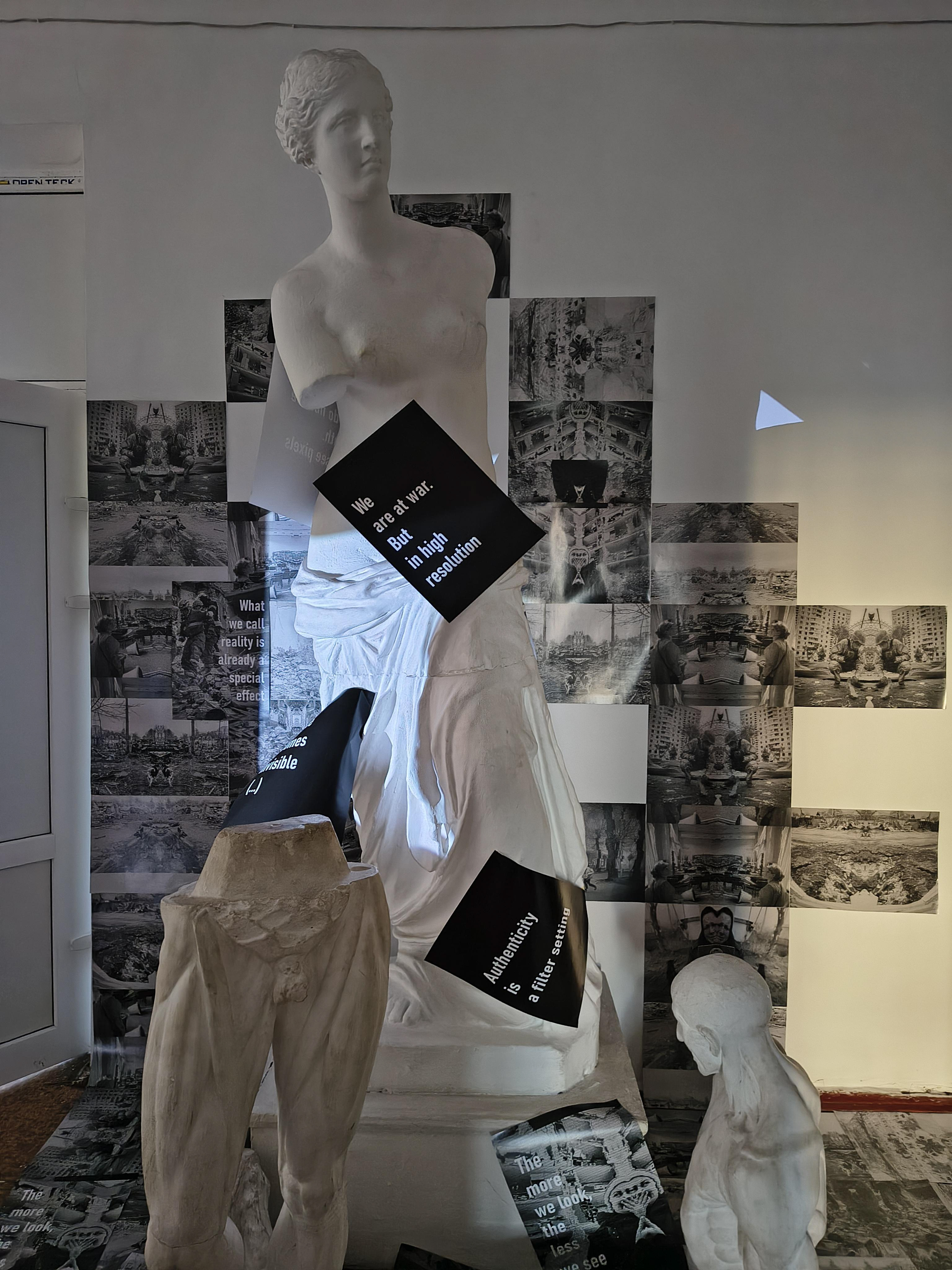
Wojna której nie ma III (2025), Galerie B, Frankfurt Oder
/ A War That Doesn't Exist III (2025), Galerie B, Frankfurt Oder
/ A War That Doesn't Exist III (2025), Galerie B, Frankfurt Oder
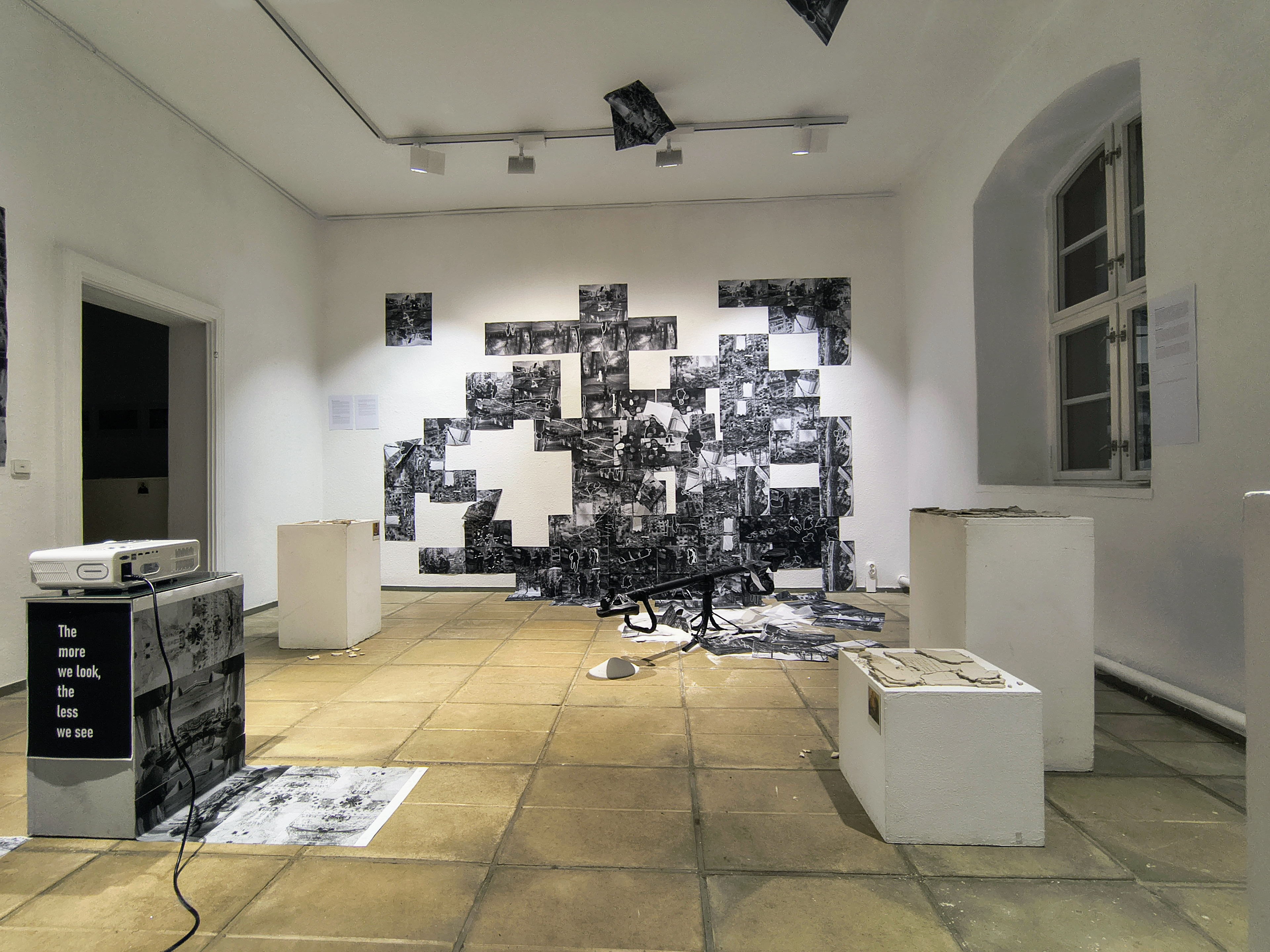
Environment powstał jako kolejna odsłona projektu podejmującego krytyczną refleksję nad hiperrealnością wojny. Odwołując się do myśli Jeana Baudrillarda, instalacja wskazuje na stan, w którym obrazy przemocy i cierpienia funkcjonują w obiegu jako symulakry – czyli przedstawienia oderwane od rzeczywistości, powielające i zastępujące ją do tego stopnia, że zaczynają tworzyć własną, autonomiczną rzeczywistość medialną. Materiał wizualny tworzą glitchowe rejestracje i found footage z massmediów relacjonujących wojnę w Ukrainie. Zanurzone w szumie, budują immersyjny pejzaż dezinformacji, przesytu i dezorientacji, która stała się bronią samą w sobie w rosyjskiej wojnie medialnej. Environment nie rekonstruuje faktów – odsłania stan znużenia, zobojętnienia graniczącego z irytacją. Obrazy i dźwięki w pętli tworzą doświadczenie natrętnej obecności, która paradoksalnie unieważnia samą wojnę – czyniąc z niej medialne widowisko, w którym realne ginie w nadmiarze.

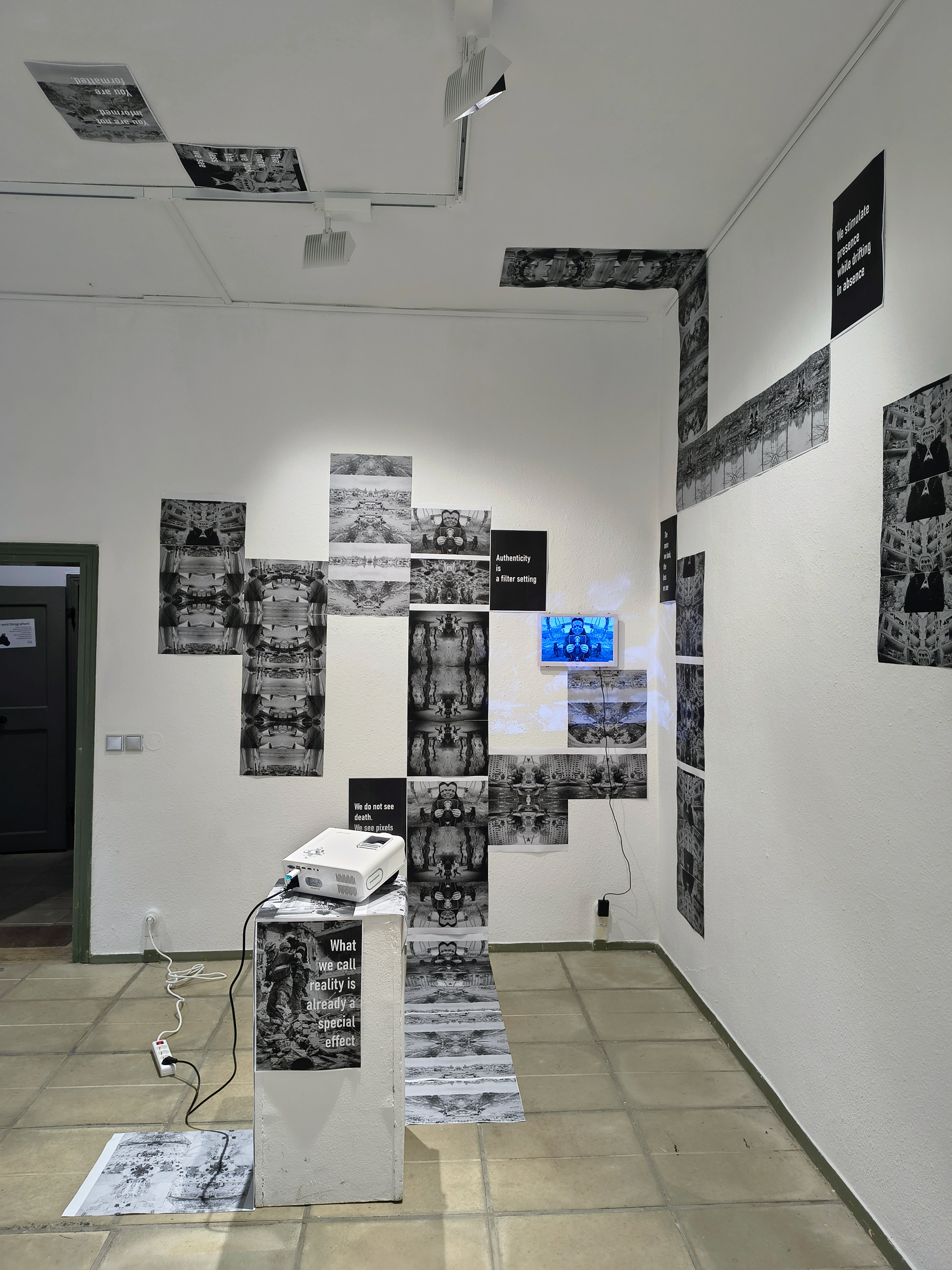
The environment was conceived as a subsequent chapter of a project that develops a critical reflection on the hyperreality of war. Referring to Jean Baudrillard's thought, the installation points to a state in which images of violence and suffering circulate as simulacra — representations detached from reality, endlessly reproduced and replacing it to such an extent that they begin to form their own autonomous medial order. The visual layer consists of glitch-based recordings and found footage taken from mass-media coverage of the war in Ukraine. Immersed in noise and distortion, they create an atmospheric landscape of disinformation, excess, and disorientation — affective strategies that have themselves become weapons in Russia’s media war. The environment does not reconstruct facts. Rather, it reveals a condition of fatigue and indifference, at times bordering on irritation. Images and sounds, arranged in continuous loops, produce an experience of intrusive presence that — paradoxically — empties the war of its meaning, turning it into a mediated spectacle in which the real disappears under the weight of its own excess.
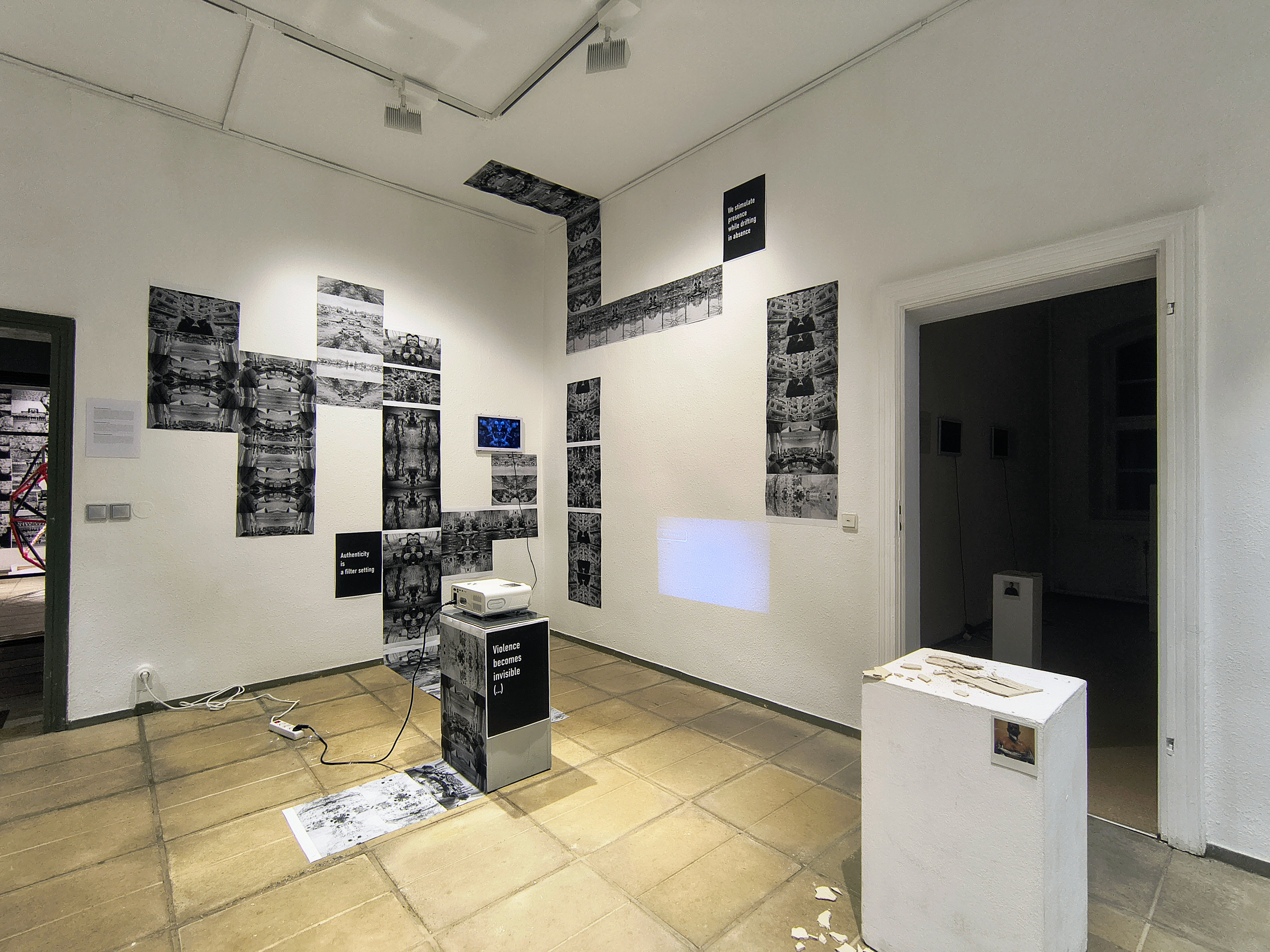
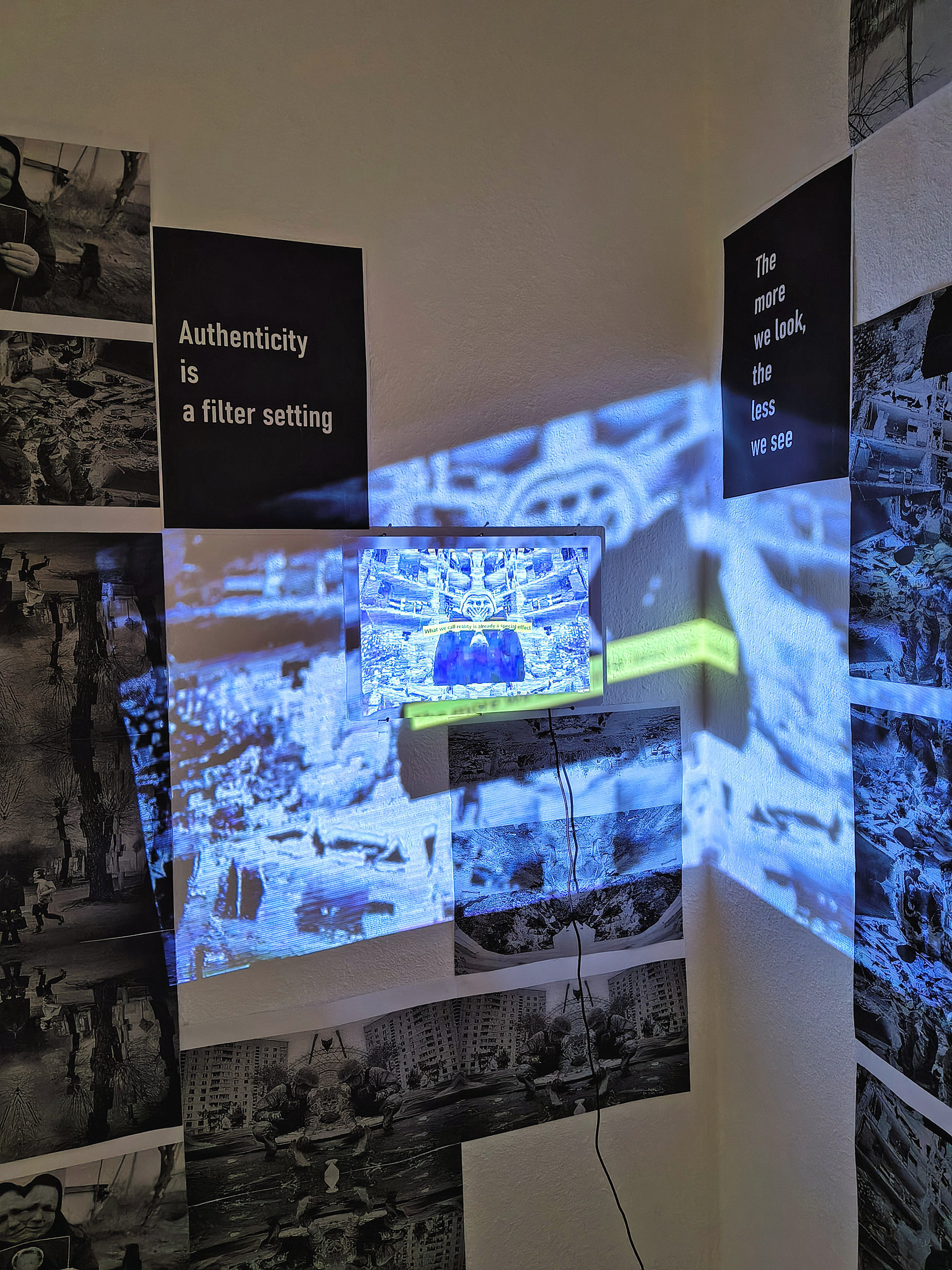
Wojna której nie ma (odsłona równoległa, 2025), Galerie B, Frankfurt Oder
/ A War That Doesn't Exist III (parallel iteration, 2025), Galerie B, Frankfurt Oder
/ A War That Doesn't Exist III (parallel iteration, 2025), Galerie B, Frankfurt Oder
Projekt wykorzystuje glitchowe rejestracje i multiplikacje mass medialnych obrazów wojny w Ukrainie. Tutaj dominuje defragmentacja i rozpad: obrazy ulegają rozproszeniu niczym pył astralny, w otwartym układzie, który nieustannie unieważnia i deprecjonuje przedstawienie. Materia papierowego medium staje się nośnikiem zniszczenia: zwielokrotnione kadry rozpadają się, tracą integralność, ich powierzchnia kruszeje i blaknie. Zastosowany biały kontur wyrywa elementy z czarno-białej kopii, odsłaniając pustkę przekazu i ujawniając niejednoznaczność samego aktu reprezentacji.
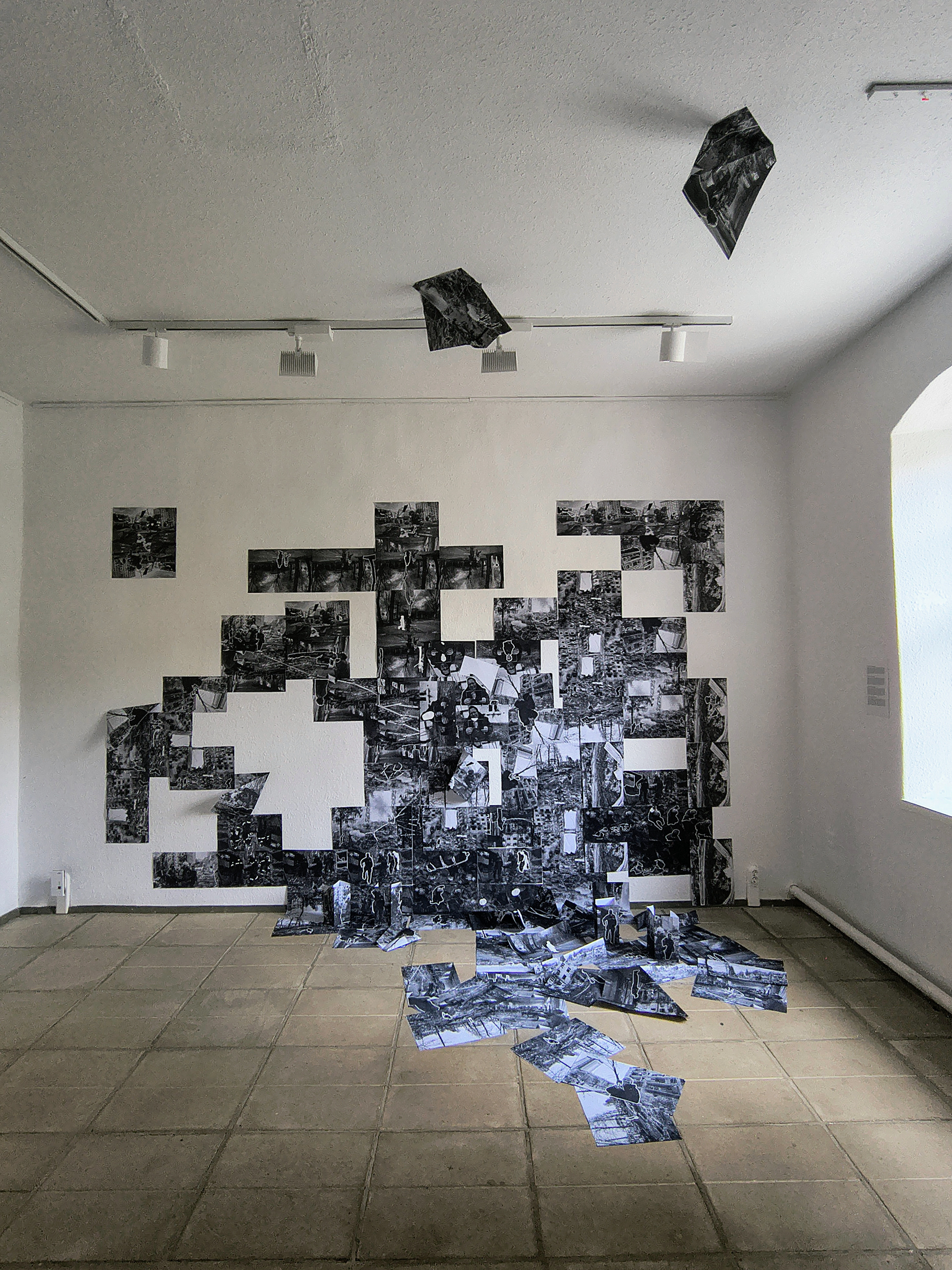

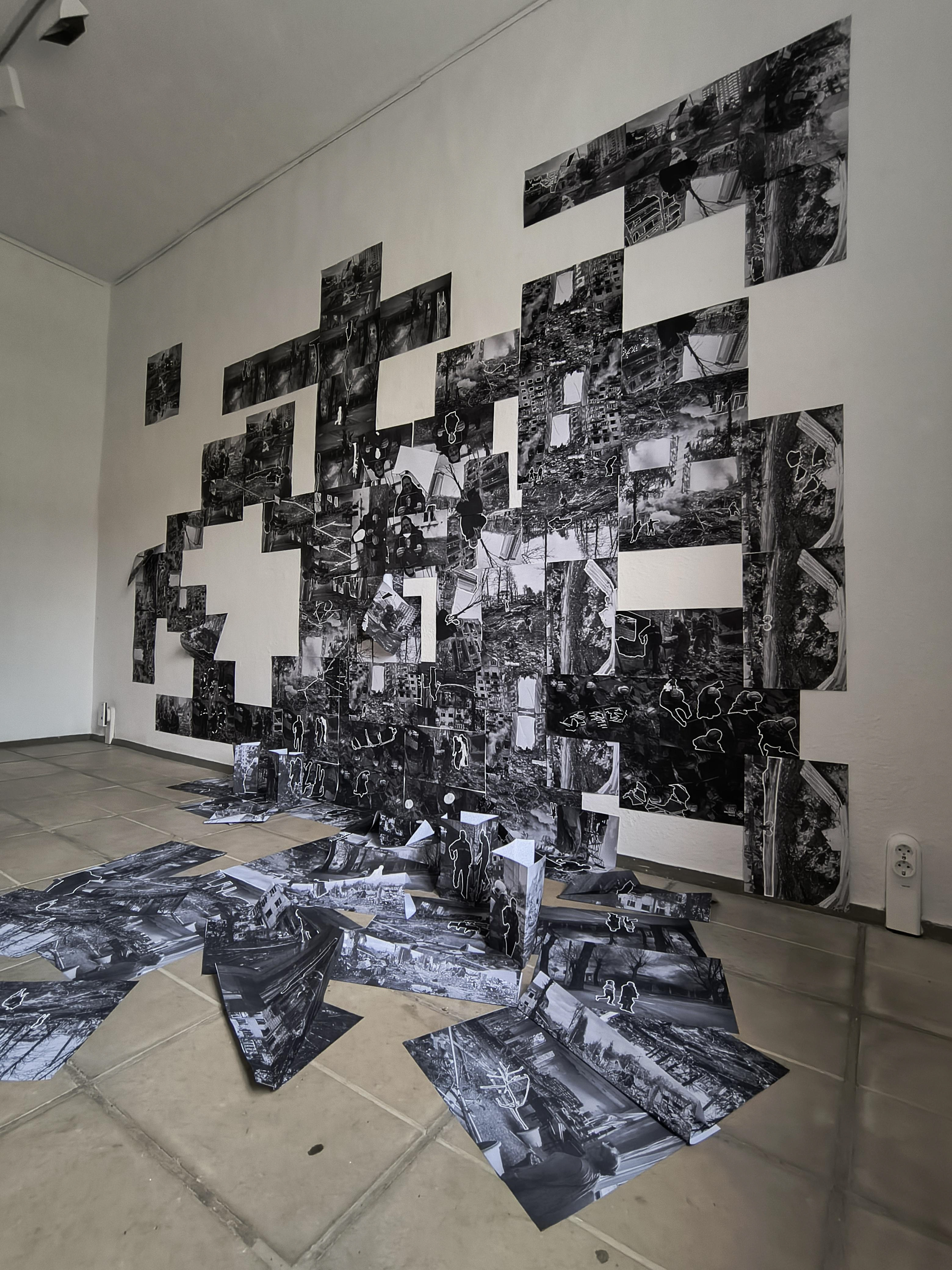
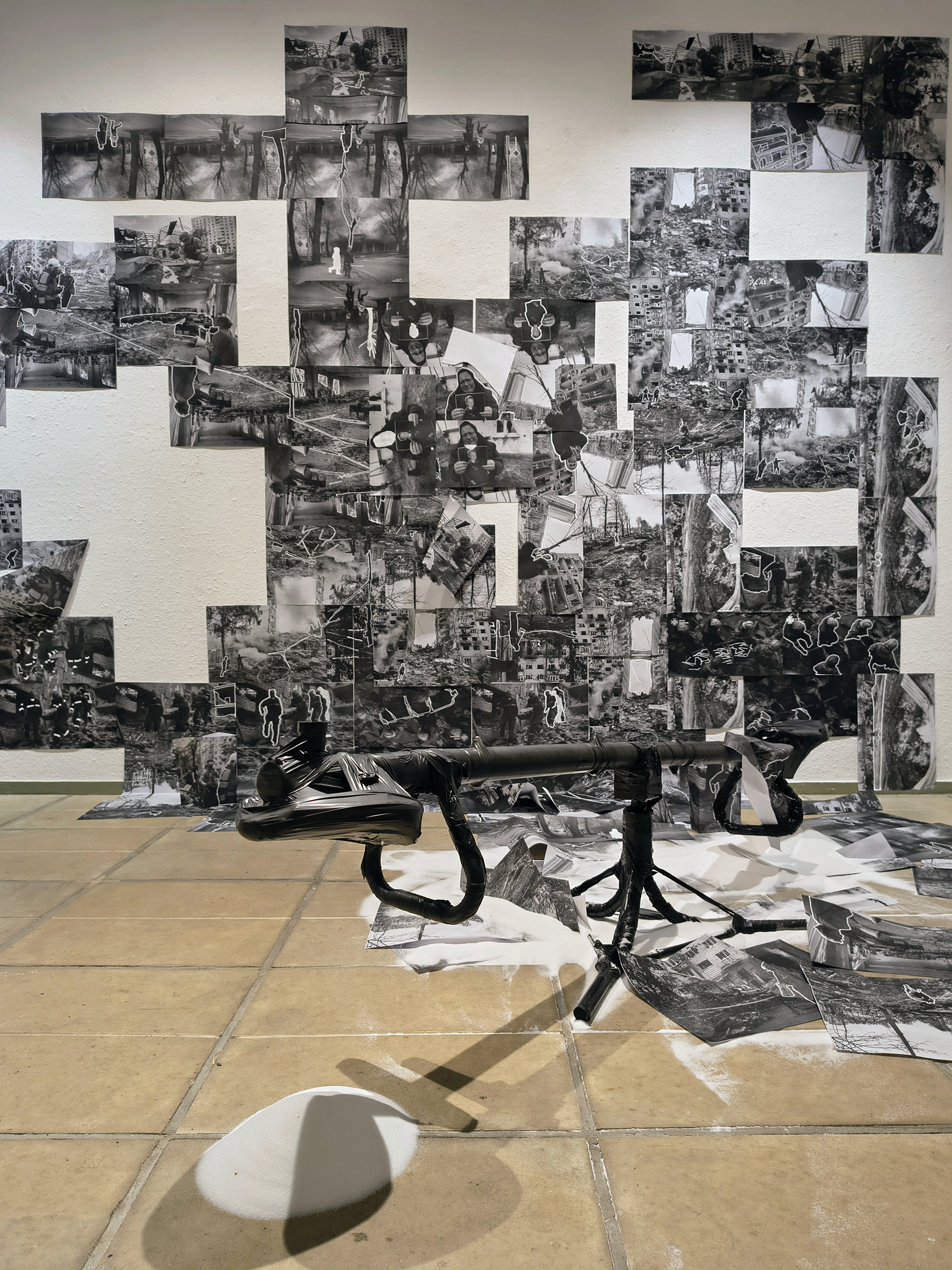
W centrum instalacji zawieszona jest huśtawka – obleczona czarną aksamitną materią, która zmienia ją w monolit. Jej forma wydaje się ciężka, niemal nieużywalna. Monolityczność blokuje ruch, a sposób zamocowania siedziska uniemożliwia wygodne osadzenie się użytkownika. Huśtawka staje się więc przedmiotem sprzecznym: jednocześnie zaprasza i odrzuca, prowokuje gest, którego nie da się w pełni wykonać. W swojej nieużytkowej formie odsyła do ciała uwięzionego w napięciu – między ruchem a bezruchem, pragnieniem a niemożnością działania. Umieszczona pośród fragmentów rozpadających się obrazów wojny, huśtawka tworzy oś całego environmentu – dramatyczny punkt ciężkości w przestrzeni pełnej wizualnych szczątków. Wokół niej osiada sól, symbol o naturze ambiwalentnej: znak oczyszczenia i zachowania, ale też bólu, łez i potu. Sól staje się tu materią graniczną, łączącą proces destrukcji z gestem ocalenia.
Ten gest wpisuje pracę w tradycję współczesnej kultury kolażu i absurdu, a zarazem odsłania jej hipokryzję: mechaniczne powielanie obrazów wojny, które – jak pisał Walter Benjamin – tracą aurę i stają się pustymi znakami wyrwanymi z kontekstu, bezlitośnie przemielając dramat rzeczywistości. Instalacja nie oferuje całościowego obrazu; przeciwnie – ukazuje proces rozpadu znaczeń i fragmentaryczności uwagi, w którym wojna przekształca się w mgławicę reprodukcji, pozbawioną spójnego sensu, zawieszoną między doświadczeniem realnym a jego symulacją.
The project utilizes glitch-based recordings and mass-media images of the war in Ukraine, which are then multiplied. Here, fragmentation and disintegration prevail: the images disperse like astral dust within an open structure that constantly destabilizes and negates representation. The paper medium becomes a carrier of destruction: repeated frames fracture, lose their integrity, and their surface crumbles and fades. The use of a white contour extracts fragments from the black-and-white copies, exposing the emptiness of the message and revealing the ambiguity of representation itself.
At the center of the installation hangs a swing, draped in black velvet that transforms it into a monolith. Its form appears heavy, almost unusable. The monolithic surface blocks movement, while the seat's position prevents the user from sitting comfortably. The swing thus becomes a contradictory object – one that simultaneously invites and rejects, provoking a gesture that cannot be completed. In its non-functional form, it alludes to a body caught in tension, suspended between motion and stillness, desire and inability to act.
Placed among fragments of disintegrating war imagery, the swing forms the axis of the entire environment – a dramatic point of gravity within a space filled with visual debris. Around it settles salt, a substance of ambivalent nature: a sign of preservation and purification, but also of pain, tears, and sweat. Here, salt becomes a liminal material connecting destruction with the possibility of redemption.
This gesture situates the work within the tradition of contemporary collage and the aesthetics of the absurd, while also exposing their hypocrisy – the mechanical reproduction of war imagery which, as Walter Benjamin wrote, loses its aura and becomes a hollow sign torn from context, relentlessly consuming the drama of reality. The installation does not offer a complete image; instead, it reveals a process of semantic decay and fragmented attention, in which war transforms into a nebula of reproductions devoid of coherence, suspended between real experience and its simulation.
Wojna której nie ma II (2025), Dniepropietrowskie Kolegium Kultury i Sztuki w ramach 9. Festiwalu Konstrukcja, Dniepr / A War That Doesn't Exist II (2025), Dnipro Art College under the frame of the 9th Construction Festival